
Why a no-logs VPN means nothing without an audit
Every VPN on earth claims to keep no logs. That claim is only as good as the proof behind it — and most companies have none.
July 1, 2026 · 9 min read
TL;DR — A “no-logs policy” is a marketing claim until someone independent verifies it. Unaudited VPNs ask you to take their word for it; audited VPNs let a third party check the servers, configs, and code. This post explains what no-logs really means, why unaudited claims are risky, and shares LunoVPN’s independent audit.
Search for any VPN and you’ll see the same three words plastered across the homepage: strict no-logs policy. It has become table stakes — so common that it’s almost meaningless. If every provider says it, how do you know which ones actually mean it?
The uncomfortable truth is that a privacy policy is just a document. A company can write “we don’t keep logs” while quietly recording your IP address, the sites you visit, and when you connect. You have no way to see inside their servers. The only thing that turns a no-logs claim from a promise into a fact is independent verification — an audit.
What a “no-logs policy” actually means
Not all logs are equal. When a VPN talks about “no-logs,” the details matter enormously. There are three broad categories:
Usage (activity) logs
The sites you visit, DNS queries, files you download. The most invasive — a true no-logs VPN keeps none.
Connection (metadata) logs
Your real IP, connection times, bandwidth, which server you used. Seemingly harmless, but enough to de-anonymize you.
Aggregate logs
Anonymous, non-identifying totals (e.g., total load). Acceptable only if they truly can’t be traced to a person.
The trick some providers use is to loudly promise “no usage logs” while still keeping connection logs that can tie an IP to a time and a session — which is often all it takes to identify someone. A genuine no-logs VPN keeps neither, and can prove it.
What your VPN could be storing
Every connection passes through your VPN’s servers. The only question is whether they keep a record. Toggle no-logs on and off to watch the difference in real time:
Illustrative demo. A logging VPN quietly builds a profile you never see; a no-logs VPN processes the packet and immediately forgets it.
Why keeping logs is dangerous for you
If a VPN stores logs, those records don’t just sit there harmlessly. They become a liability the moment anyone else wants them:
Legal & government requests
Authorities can compel a company to hand over whatever it holds. No logs means nothing to hand over.
Data breaches
Stored logs get hacked. If they never existed, they can’t leak.
Selling your data
“Free” VPNs have been caught monetising user activity. Logs are the product.
Profiling & surveillance
Connection metadata alone can reconstruct who you are, where you are, and what you do.
The problem: a policy is just words
Here’s the part the industry doesn’t like to say out loud: you cannot verify a no-logs claim from the outside. You can’t see the servers. You can’t read the configuration. You can’t inspect the code that routes your traffic. You are trusting a sentence on a webpage.
And that trust has been broken before. Across the industry there have been multiple documented cases of providers that advertised “no-logs” and were later found — through court records, data breaches, or leaked servers — to have been storing user data all along. Sometimes the logging was accidental; sometimes it was the business model. Either way, users only found out after the damage was done.
The lesson is simple: a no-logs policy you can’t verify is not a feature, it’s a hope.
The data-request test
This is the moment that separates a real no-logs VPN from a paper one. An authority sends a request for everything a provider has on a user. Press the button and compare the two responses:
Why you shouldn’t trust an unaudited VPN
An independent audit is when a qualified outside firm — one with no stake in the outcome — is given real access to a VPN’s systems and asked one question: does the reality match the promise? They inspect the servers, the configurations, the data-handling procedures, and often the source code, then publish what they found.
Without that, a “no-logs” badge is self-graded homework. Consider what an unaudited provider is really asking of you:
- Trust us that our servers aren’t logging — even though you can’t look.
- Trust us that a stranger with your data has your best interests at heart.
- Trust us that nothing has changed since we wrote that policy.
Auditing replaces “trust us” with “check for yourself.” It’s the difference between a company that says it’s private and one that has proven it. When a provider has never been audited, the honest question isn’t “why would they lie?” — it’s “why should you have to guess?”
What an independent audit actually checks
A serious no-logs audit goes well beyond reading the privacy policy. A thorough review typically covers:
Server configuration
Inspecting live servers to confirm logging is disabled and no user data is written to disk.
infrastructure
Verifying servers run diskless from memory, so all data is wiped on every reboot.
Source code & systems
Reviewing the software and back-end that handle traffic, auth, and diagnostics for hidden logging.
Policies & processes
Interviews and document review to confirm internal practices match the public no-logs claim.
LunoVPN’s independent audit
We don’t just claim no-logs — we had it verified. An independent firm was given hands-on access to our infrastructure and asked to confirm whether we keep any data that could identify a user. Here’s the summary:
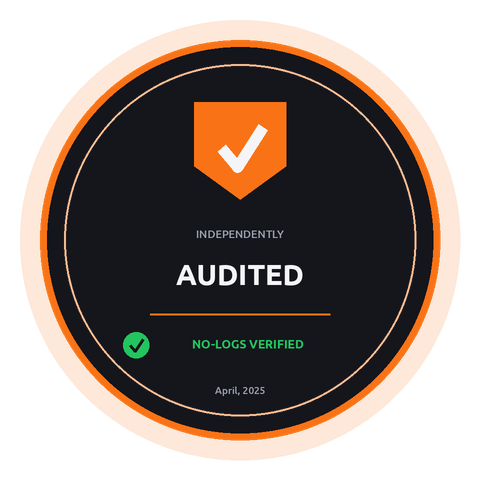
Replace the bracketed fields and the report link with your real audit details before publishing.
How LunoVPN is built to keep no logs
An audit confirms what our architecture is designed to guarantee. Keeping no logs isn’t a setting we toggle — it’s baked into how the network is built:
RAM-only servers
Our servers run entirely from volatile memory with no hard drives. Every reboot wipes everything — there’s nowhere for logs to persist.
No identifying records
We don’t store your real IP, browsing, DNS queries, or connection timestamps. There’s no profile to build.
Anonymous payment
Pay with Monero and there’s no name or card tied to your account either — privacy end to end.
Verified, not asserted
The independent audit is our receipt: proof that the reality matches the promise.
How to vet any VPN’s no-logs claim
Don’t take our word for it either — use this checklist on any provider, including us:
- Has it been independently audited? Look for a named firm, a date, and a published report — not just the word “audited.”
- Is the report recent? Infrastructure changes — a five-year-old audit says little about today.
- Does it run RAM-only servers? Diskless infrastructure makes long-term logging practically impossible.
- What’s the jurisdiction? Understand which laws could compel data — and remember no logs means nothing to compel.
- Is the policy specific? Vague wording like “we respect your privacy” is a red flag; real policies name exactly what is and isn’t kept.
Privacy you don’t have to take on faith
LunoVPN is built for no-logs and independently audited to prove it. Encrypt everything, hide your IP, and pay anonymously.
Get LunoVPN