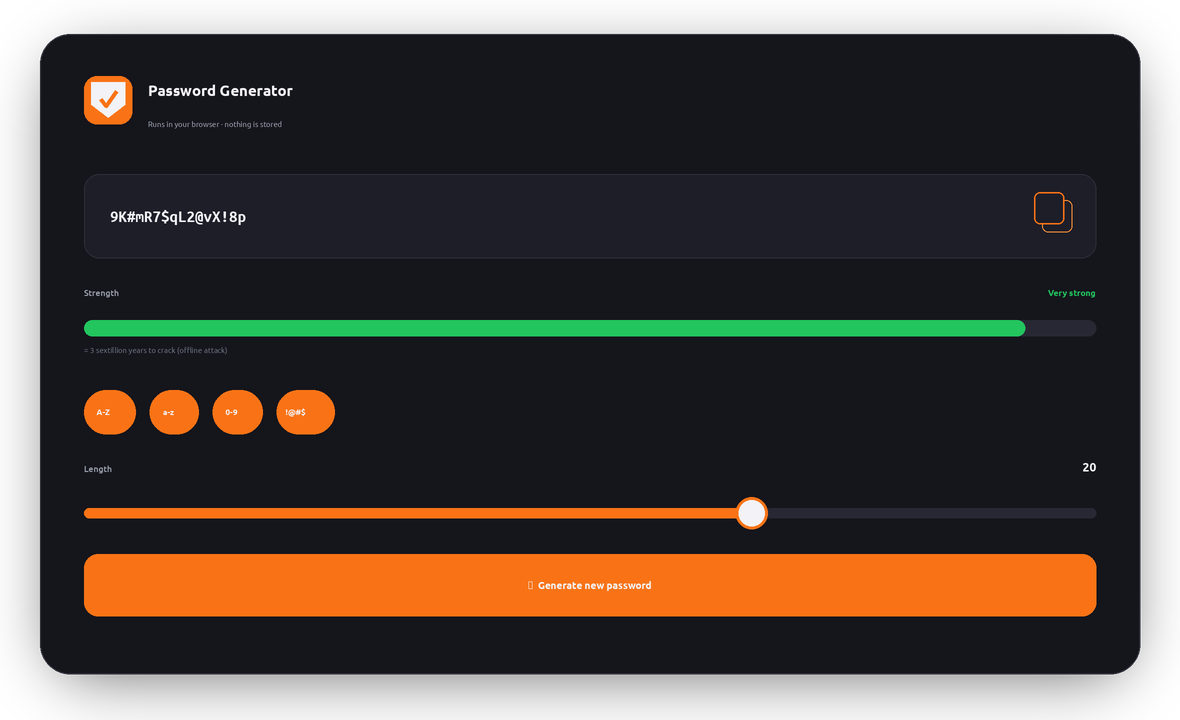
Weak and reused passwords are behind most account hacks. Generate a unique, uncrackable password below, check how long it would take to break, and learn how to keep every account safe.
Email, banking, work, social media, cloud storage — almost everything you own online sits behind a password. If that password is weak, guessable, or reused on another site that gets breached, attackers can walk straight in.
The problem is scale. The average person now juggles dozens to hundreds of accounts, so people reuse the same few passwords everywhere. When one service is breached, those credentials are tried automatically across thousands of other sites — a technique called credential stuffing.
A strong password fixes this at the root: it’s long, random, and unique to each account, so it can’t be guessed, brute-forced in any reasonable time, or reused against you elsewhere.
Commonly reported figures from industry breach and security research paint a clear picture:
Figures are widely-cited industry estimates and are shown for illustration — verify against current sources before publishing.
Pick a password and unleash a simulated attacker guessing 100 billion combinations per second. See how fast a weak one falls — and why a strong one never does:
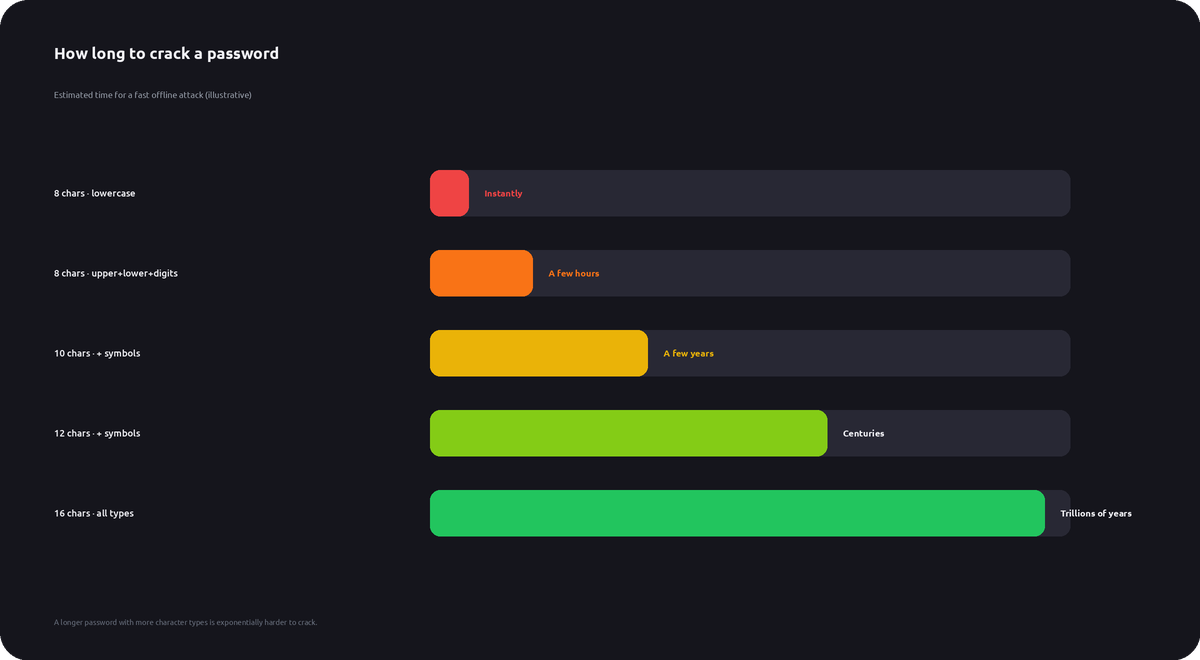
Strength comes down to entropy — how unpredictable a password is. Two things drive it up: how many possible characters you use, and how long the password is. Length matters most, because each extra character multiplies the number of possibilities.
Trying every possible combination. Fast against short passwords, hopeless against long random ones.
Guessing real words, names, and known-common passwords first — which is why “password1” falls instantly.
Replaying passwords leaked from one breach across thousands of other sites you reused them on.
Tricking you into typing your password into a fake login page. No password survives being handed over.
Pre-computed hashes that instantly reverse unsalted, weakly-hashed passwords from a leak.
Recording what you type. A VPN and good device hygiene reduce exposure on risky networks.
Generate a fresh random password for each account with the tool above.
You can’t remember 100 random passwords — let a manager store and autofill them.
Two-factor authentication blocks logins even if a password is stolen.
If a site you use is breached, replace that password immediately — and anywhere you reused it.
Passwords sent by email or chat can be intercepted or sit in inboxes forever.
LunoVPN encrypts your traffic so logins can’t be sniffed on shared networks.
This generator runs entirely in your browser using your device’s cryptographic randomness. Passwords are never sent to our servers, logged, or stored — the same no-logs principle behind everything LunoVPN builds.
Lock down your accounts, then encrypt everything you do online with LunoVPN.
Get LunoVPN