
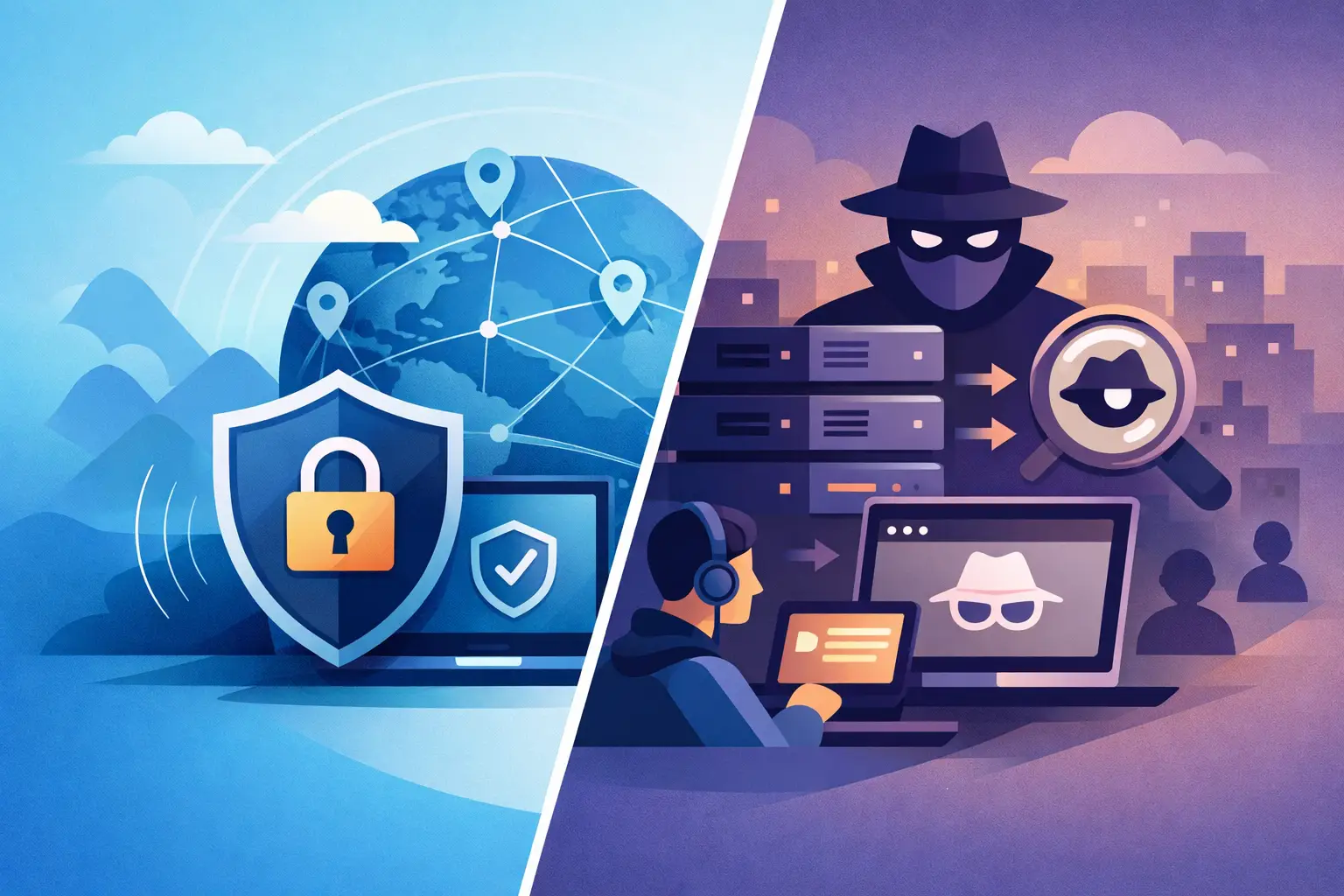
That “private” browsing setup might be doing far less than you think. In the vpn vs proxy privacy debate, the real question is simple: what actually protects your traffic, your identity, and your data when you connect from a coffee shop, airport, hotel, or home network?
A lot of people treat proxies and VPNs like interchangeable tools. They are not. Both can change your visible IP address. Both can help you appear to connect from somewhere else. But privacy is not just about looking like you are in another country. It is about what stays hidden, who can still see your activity, and what happens when your connection fails.
VPN vs proxy privacy: the short answer
If privacy is the goal, a VPN is usually the stronger choice. A proxy can reroute certain traffic through another server, but it often does not encrypt everything leaving your device. That means your internet provider, the local network operator, or anyone monitoring an unsecured connection may still see more than you expect.
A VPN creates an encrypted tunnel between your device and the VPN server. That protects your traffic in transit and masks your IP at the same time. It is the difference between changing the return address on a letter and putting the letter itself in a locked container.
That does not mean every VPN is automatically private, or every proxy is useless. It depends on what you are trying to protect, how the service is configured, and how much exposure you are willing to accept.
What a proxy actually does
A proxy server sits between you and the website or app you are trying to reach. Instead of connecting directly, your request goes through the proxy first. The destination sees the proxy server’s IP address rather than yours.
That can be useful for simple tasks. You might use a proxy to access a geo-restricted page, test how a site appears from another region, or mask your IP in a browser session. In those narrow cases, a proxy can get the job done.
But privacy is where the limits show up fast. Many proxies only handle traffic from one app or one type of protocol, such as your browser. Other apps on your device may still connect normally in the background. Your messaging app, cloud backup, operating system services, and software updates may continue exposing your real network path.
And encryption is the big dividing line. Some proxies do not encrypt traffic at all. Even when a website itself uses HTTPS, a proxy is not giving you full-device encrypted protection. It is mostly acting as a traffic middleman, not a privacy shield.
What a VPN does differently
A VPN is built to protect traffic, not just reroute it. Once connected, it encrypts the data moving between your device and the VPN server. That blocks local snoops from reading your activity on public Wi-Fi and makes it far harder for network observers to profile what you are doing.
It also works at the device or system level, not just inside a single browser tab. That matters more than people realize. Real privacy problems do not come from one website alone. They come from everything running in parallel across your phone, laptop, tablet, or smart TV.
A quality VPN also closes common gaps that basic proxy use does not address. Private DNS routing helps prevent your DNS requests from leaking outside the tunnel. A kill switch can stop traffic if the VPN connection drops unexpectedly. A no-logs policy matters because your privacy should not just be hidden from outsiders while being stored by the service itself.
Those are not extras for power users. They are the details that separate appearance from protection.
VPN vs proxy privacy in real-world situations
If you are on public Wi-Fi, a proxy is a weak answer. It may change your IP for certain traffic, but it usually will not secure your full connection against interception. A VPN is designed for exactly this situation because it encrypts your traffic before it leaves the device.
If you want to stream content from another region, either tool might help with location switching. But that is a streaming question, not a privacy one. A proxy may be enough if your only goal is to appear somewhere else. If you also want your connection protected from tracking, ISP visibility, or local network monitoring, a VPN is the better fit.
If you live under heavier censorship or travel frequently, the gap gets wider. A proxy may help with access in some cases, but it is generally less dependable and less protective. A VPN gives you a stronger layer of control over both access and confidentiality.
If you are trying to reduce tracking, neither tool makes you invisible by itself. Websites can still use cookies, browser fingerprinting, account logins, and other identifiers. But a VPN reduces one important signal – your real IP address – while also shielding traffic on the network path. A proxy only handles part of that equation.
Where proxies still make sense
There are legitimate uses for proxies. If you need a lightweight tool for a specific browser task, a proxy can be quick and simple. Some businesses use proxies for traffic filtering, caching, or automation workflows. Developers may use them for testing. In those cases, the goal is often routing or control, not privacy.
That distinction matters. A proxy is not bad because it is limited. It is bad only when it is mistaken for something it is not.
Free proxies deserve extra caution. They often lack transparency, may inject ads, can break sites, and sometimes log more than users realize. If a service is handling your traffic, trust is not optional.
Why privacy depends on more than encryption alone
Encryption is the foundation, but not the whole story. A VPN can protect traffic in transit, yet privacy still depends on what the provider does behind the scenes. If a VPN keeps detailed activity logs, sells usage data, or leaks DNS requests, the protection story weakens fast.
That is why serious users look beyond the basic label. They look for verified no-logs practices, leak protection, stable protocols, and fail-safe features. They want a service that protects them quietly across devices without asking them to babysit every connection.
This is also why a premium VPN service tends to deliver more meaningful privacy than a random browser proxy. Better infrastructure, stronger protocols, wider server coverage, and built-in protections all add up to a more reliable result. Privacy should not collapse the moment a network changes or an app behaves differently.
How to choose between a proxy and a VPN
Start with your actual goal. If all you need is to route one browser session through another IP, a proxy may be enough. Just be honest that you are choosing convenience over comprehensive protection.
If your goal is privacy across your device, safer browsing on public networks, reduced exposure to ISP monitoring, and stronger control over your digital footprint, choose a VPN. That is the tool designed for the job.
For most everyday users, the deciding factor is not technical complexity. It is risk. Where are you connecting from? How often do you travel? Do you use public Wi-Fi? Do you care whether your provider can see your traffic patterns? Do you want protection that covers your phone and laptop, not just one browser?
If those questions matter to you, the answer usually points in one direction.
The better standard for online privacy
The vpn vs proxy privacy question becomes much easier once you stop thinking about IP masking as the whole game. Real privacy means encrypted traffic, leak protection, dependable coverage across apps and devices, and a provider that does not treat your activity as a product.
That is why VPNs have become the stronger default for people who want practical, everyday protection. Not because they are flashy, but because they cover more of the problem. A modern service such as LunoVPN is built around that standard – secure traffic, private DNS, kill switch protection, and a no-logs approach that puts user control first.
Privacy should not be partial. It should work when you are at home, at the airport, on hotel Wi-Fi, or crossing borders. If you care about staying harder to track and safer to connect, choose the tool that protects the connection itself, not just the appearance of it.


