
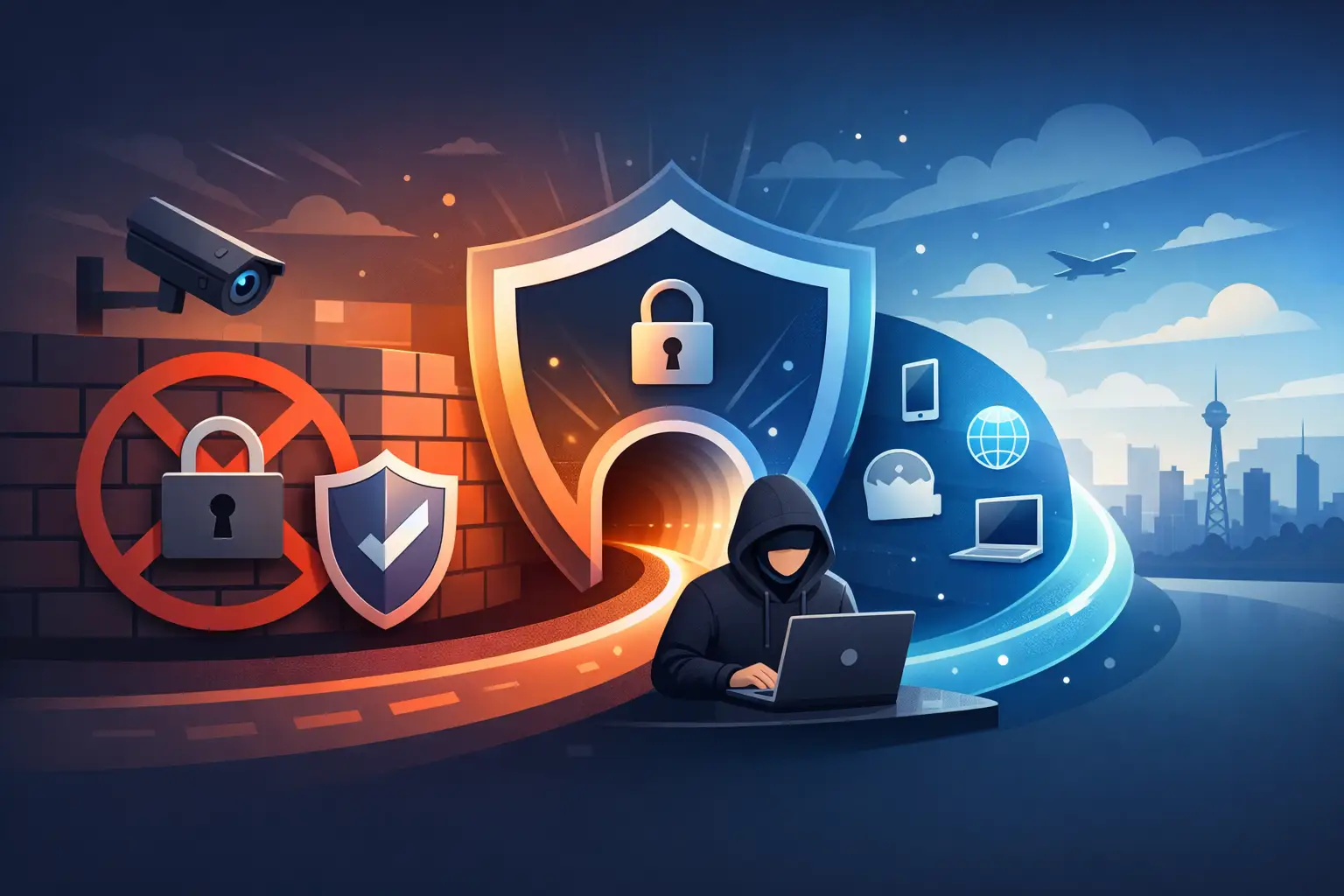
Some blocks are obvious. A website refuses to load, a streaming app grays out, or your messages stop sending the moment you connect to public Wi-Fi in a restrictive country. Other blocks are quieter – throttled traffic, broken DNS requests, and apps that suddenly act like the internet is half gone. That is where vpn censorship bypass becomes less of a convenience and more of a basic privacy tool.
A VPN can help you reach an open internet, but not every VPN is built for censorship-heavy networks. Some get detected fast. Some leak DNS traffic. Some slow down so badly that even if they connect, they are barely usable. If your goal is reliable access, privacy, and control, the details matter.
What vpn censorship bypass really means
At a basic level, censorship bypass means routing your traffic through an encrypted tunnel so local networks, internet service providers, or state-level filtering systems cannot easily see what you are accessing. Instead of your requests going out in the clear, they pass through a VPN server in another location.
That sounds simple, but real-world censorship is not always a basic website block. Some networks use DNS tampering to redirect requests. Others inspect traffic patterns and try to identify VPN protocols. Some restrict specific platforms, while others disrupt encrypted connections altogether. A VPN that works fine at home may struggle on a tightly controlled hotel network, campus Wi-Fi, or in a country with aggressive filtering.
So the goal is not just to “use a VPN.” The goal is to use one that can stay connected, keep your activity private, and avoid obvious leaks when the network pushes back.
Why some VPNs fail under censorship
The biggest reason is visibility. If a network can easily recognize VPN traffic, it can block or throttle it. This often happens when a provider relies on older or poorly disguised protocol behavior. The connection may start, then drop repeatedly, or never establish at all.
The second problem is infrastructure. A small server network can become crowded, slow, or easier to blacklist. If too many users exit through a narrow set of IP addresses, those addresses get flagged faster. A broader server footprint gives users more options and makes it easier to switch when one route is restricted.
Then there is leak protection. If DNS requests go outside the tunnel, the network can still see what domains you are trying to access. If the VPN disconnects without a kill switch, your real IP can be exposed in the middle of a session. Under censorship, those are not minor technical issues. They defeat the point.
The features that matter most for censorship bypass
If you want a vpn censorship bypass setup that holds up under pressure, start with encryption and protocol support. Strong encryption protects the contents of your traffic, but the protocol determines how that traffic moves and how visible it looks on the network. OpenVPN, IKEv2, and IPSec all have strengths depending on the device, network conditions, and how aggressive the filtering is.
Private DNS is another key piece. When your VPN handles DNS requests internally, you reduce the chance of local networks seeing or manipulating your domain lookups. That helps with both privacy and reliability.
A kill switch matters more than many people realize. On unstable or filtered networks, disconnects happen. A kill switch stops your device from sending traffic outside the VPN if the tunnel drops. Without it, a momentary interruption can expose your real location and browsing activity.
Tracker blocking also helps in a less obvious way. Cutting down on third-party connections reduces background noise, speeds up browsing, and limits the amount of extra data leaking to ad and analytics networks. It is not the core of censorship bypass, but it supports the same goal: less exposure, more control.
VPN censorship bypass on different networks
Not all restrictions behave the same way, and that changes what users should expect.
On public Wi-Fi, blocks are often inconsistent. You may be dealing with captive portals, content filters, or traffic shaping rather than full-scale censorship. In those cases, a VPN usually works well if it connects cleanly after login. The bigger issue is security. Open Wi-Fi is already risky, so encryption and kill switch protection matter from the first minute.
On school or workplace networks, filtering may be targeted. Social apps, streaming sites, chat tools, and forums are often blocked while business traffic stays open. A VPN can help restore access, but users should also understand local rules and acceptable use policies. Bypass technology can solve the technical problem, not the policy one.
On heavily restricted national networks, it gets harder. Some systems actively identify and suppress VPN traffic. Here, reliability depends on protocol flexibility, strong leak prevention, and a service that can adapt as restrictions change. This is where premium infrastructure tends to outperform bare-bones apps.
Speed matters more than people expect
A VPN that technically bypasses censorship but turns every page load into a waiting game is not a real solution. Speed affects whether you can actually work, message, stream, or make calls without constant friction.
That is why server distribution matters. The closer the exit server is to your real location, the better your speeds are likely to be. But under censorship, the nearest server is not always the best server. Sometimes a nearby region is still filtered or congested, while a slightly farther one offers better stability. It depends on the route.
This trade-off is normal. Stronger privacy, better bypass performance, and faster speeds do not always align perfectly on every network. Good VPNs give you options so you can adjust instead of getting stuck.
How to choose a VPN for censorship bypass
Start with privacy. If a provider keeps logs, your traffic may be encrypted in transit but not truly private in practice. A verified no-logs approach matters because trust should not depend on marketing alone.
Next, look at protocol choice and platform support. You want the freedom to switch between desktop, mobile, browser, and even smart TV environments without relearning the product each time. Censorship does not happen only on laptops.
Then look at the network itself. A large server base across many countries improves your chances of finding a stable route when one region is blocked or overloaded. This is one area where scale has a practical benefit.
Finally, pay attention to the safety features people often skip over in comparisons: private DNS, tracker blocking, and a kill switch. Those are not extras for edge cases. They are part of what makes the connection trustworthy.
When a VPN helps – and when it may not be enough
A VPN is one of the best tools for bypassing many forms of online censorship, but it is not magic. If a government or network operator is aggressively disrupting encrypted traffic, even strong VPNs may require trial and error with different servers or protocols. There can be periods where access is unstable.
Users should also be realistic about device security. A VPN protects traffic in transit. It does not fix a compromised phone, weak account passwords, or unsafe downloads. If the goal is digital freedom, security habits still matter.
That is also why simplicity matters. Most people do not want to tune network settings every day. They want a VPN that protects them quietly, switches locations easily, and stays reliable across devices. LunoVPN is built around exactly that expectation – private DNS, kill switch protection, no-logs infrastructure, and a large global server network that gives users room to move when restrictions get in the way.
The best mindset for censorship bypass
Think of vpn censorship bypass as a combination of privacy, access, and resilience. Privacy keeps your traffic hidden. Access helps you reach the services and information you choose. Resilience is what keeps the whole setup useful when networks become hostile or unpredictable.
The right VPN does not just change your location. It gives you a safer path through a restricted internet, with fewer leaks, fewer interruptions, and more control over what happens to your data. That control matters whether you are traveling, using public Wi-Fi, or simply refusing to let gatekeepers decide what your connection should look like.
If you care about digital freedom, choose a VPN that treats censorship as a real-world problem, not a checkbox feature. The internet should work on your terms.


