
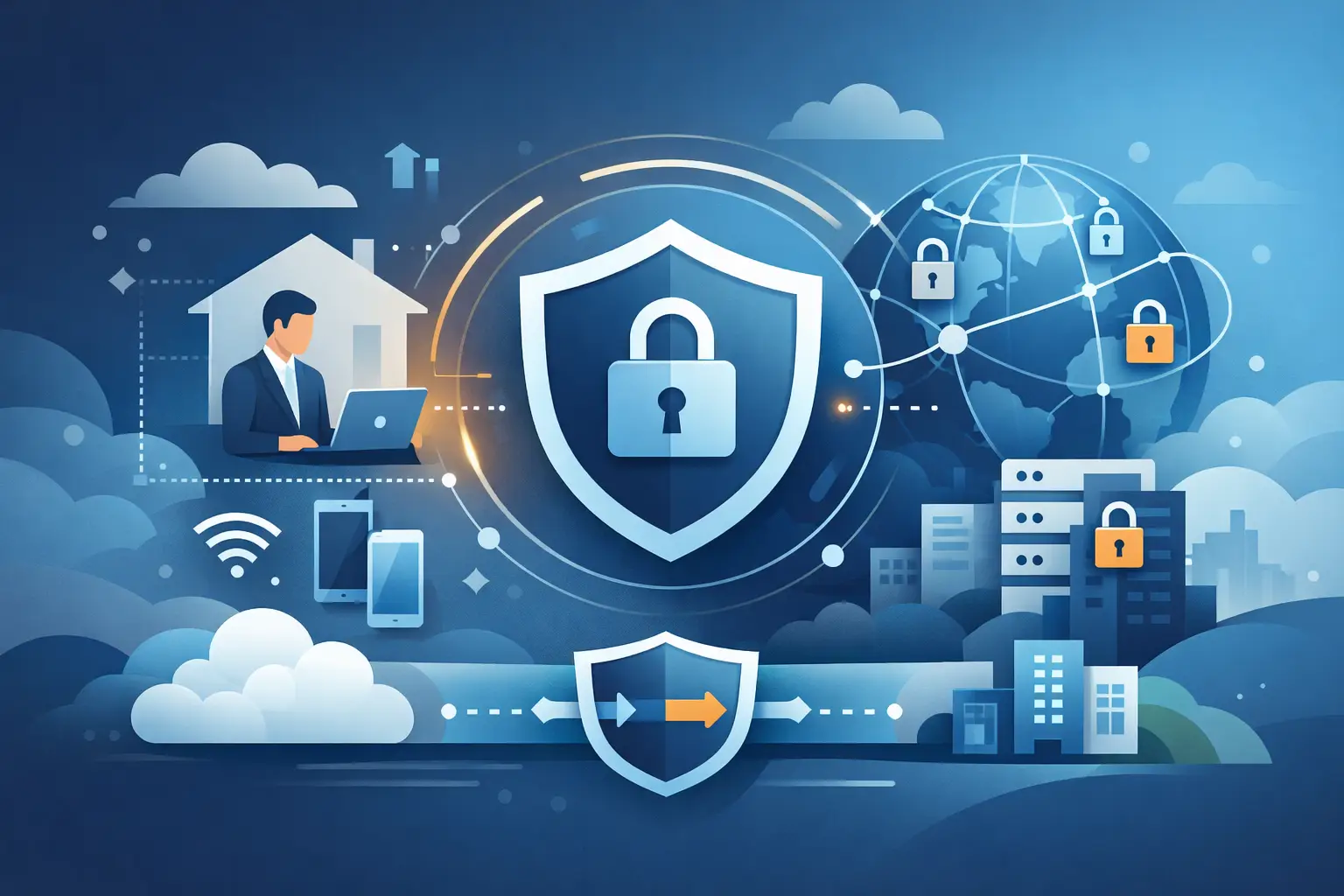
You notice a vpn most when you need it fast – at the airport, on hotel Wi-Fi, in a coffee shop, or when a site suddenly says content is not available in your region. That is the real appeal. A vpn puts control back in your hands by encrypting your traffic, masking your IP address, and giving you a safer path across the internet.
For most people, that sounds technical until the moment it becomes personal. Maybe you want less tracking. Maybe you travel and need stable access to the services you use at home. Maybe you do not like the idea of your browsing activity being exposed on public networks. A good VPN is not about paranoia. It is about basic digital boundaries.
What a VPN actually does
A VPN, short for virtual private network, creates an encrypted tunnel between your device and a remote server. Instead of sending your internet traffic out in the open through your local network, it routes that traffic through the VPN server first. That changes what outsiders can see and often changes how websites identify your location.
In practical terms, it does three things that matter to everyday users. It encrypts the traffic leaving your device, it replaces your visible IP address with the IP of the VPN server, and it can route your connection through another city or country. Those three shifts are what make private browsing, safer public Wi-Fi use, and region switching possible.
That said, a VPN is not invisibility software. It does not make you anonymous in every situation, and it does not stop every form of tracking on its own. If you are signed into an account, that service still knows it is you. If a website uses browser fingerprinting or aggressive trackers, a VPN helps but does not solve the whole problem. The strongest protection comes from layers.
Why people use a vpn
The biggest reason is privacy. Your internet provider, local network operators, and potential snoops on unsecured networks should not have an easy view into what you are doing online. Encryption helps close that window.
Security is a close second, especially on public Wi-Fi. Free networks are convenient, but convenience is not the same as safety. A trusted VPN reduces the chance that your traffic is exposed while you are checking email, logging into accounts, or sending payment details from a shared network.
Then there is access. A vpn can help you get around censorship, network restrictions, or location-based blocks by routing traffic through a server in another region. For travelers, remote workers, and streamers, this is often the difference between a usable internet experience and a frustrating one.
There is also a quieter benefit that matters more than many people realize: less profiling. A masked IP address and private DNS routing can reduce the amount of passive data collection tied to your location and browsing habits. It will not erase your digital footprint, but it can shrink it.
Where a VPN helps most
Public Wi-Fi and shared networks
This is the clearest use case. Airports, hotels, cafes, coworking spaces, and apartment building networks are all environments where you should assume limited trust. Even when the network itself is legitimate, you do not know who else is on it or how well it is secured. A VPN gives you a safer default.
Streaming and travel
If you travel across borders or spend time in different regions, you already know how often digital services change based on location. A VPN can help you access region-specific content or use the same apps and sites you rely on at home. Speed matters here. So does server coverage. A large network gives you more options and less congestion.
Privacy at home
People often think a VPN only matters outside the house. That is too narrow. Your home network is more secure than a random hotspot, but your provider can still see connection metadata, and websites still build profiles around your IP and behavior. A VPN adds another layer between you and that ecosystem.
Censorship and restrictive networks
In some places, internet access is filtered, blocked, or heavily monitored. A VPN can help users reach a more open internet by routing traffic through less restricted locations. This is one of the strongest arguments for VPN use, though performance and reliability can vary depending on local conditions and blocking methods.
What a good VPN should include
Not all VPN services offer the same level of protection. The basics matter, but the details matter more.
Encryption is the starting point. Strong standards protect traffic in transit so your data is harder to intercept. After that, look at logging policy. If a provider keeps detailed records of your activity, the privacy story weakens fast. A verified no-logs approach carries more weight than a marketing claim alone.
A kill switch is another feature worth having. If the VPN connection drops unexpectedly, a kill switch can stop your internet traffic from leaking onto the open connection. Without it, your device may quietly fall back to the regular network and expose your real IP.
Private DNS routing also matters. It helps prevent DNS requests from slipping outside the encrypted tunnel, which can reveal what sites you are trying to visit even when the rest of your traffic is protected.
Protocol support is not just a technical footnote. OpenVPN, IKEv2, and IPSec each offer different strengths around speed, compatibility, and connection stability. For everyday users, the best service is often the one that handles this automatically and gives you a fast, stable connection without forcing you to become a network engineer.
Server network size matters too, but only up to a point. More servers across more countries can improve flexibility, reduce congestion, and make it easier to find nearby fast connections. What matters is not just the number, but whether performance stays consistent where you actually need it.
The limits and trade-offs of a VPN
A VPN adds protection, but it is not magic. Because your traffic is being routed through another server and encrypted along the way, some speed loss is normal. The best providers keep that impact small, but it rarely disappears entirely.
There is also a trust trade-off. You are shifting trust away from your internet provider or local network and toward your VPN provider. That is why infrastructure, transparency, and privacy policy matter so much. A cheap or vague service can create more risk, not less.
Compatibility can be another deciding factor. If you use a laptop, phone, tablet, browser, and smart TV, you need a VPN that works across all of them without friction. Protection that only covers one device is better than nothing, but it is rarely enough.
And while a VPN can help reduce ad tracking and location profiling, it does not replace good privacy habits. Browser settings, tracker blocking, strong passwords, multi-factor authentication, and software updates still matter.
Is a VPN worth it for everyday use?
For many people, yes. If you use public Wi-Fi, care about privacy, travel often, stream across regions, or simply want more control over how your data moves online, a VPN is one of the simplest upgrades you can make. It works quietly in the background and solves a real problem.
The key is choosing one that is built around trust, speed, and practical protection rather than big promises. That means strong encryption, a no-logs stance backed by verification, private DNS, a kill switch, reliable protocols, and enough global server coverage to keep performance usable. That is the difference between a VPN you forget is running and one you uninstall after a week.
LunoVPN is built around that standard – secure, private, and fast, with broad device support and a network designed for real-world use.
Privacy is not a niche concern anymore. It is a basic expectation. A VPN will not fix every problem on the internet, but it gives you a stronger position every time you connect, and that is a smart place to start.


